


Security and safety systems are constantly being improved, and it is important to choose the right equipment for their effective operation. One of the key elements is security detectors, devices that respond to intrusion into a protected area. They come in various types, and one of the main classification criteria is the number of work positions: single-position and two-position. Let's figure out what the difference is between them and which option is better to choose for specific conditions.
Single-position security detector
A single—position detector is a device in which the transmitter and receiver (or one combined module) are located at the same point. It independently forms a detection zone and monitors it for movement or other signs of a violation.
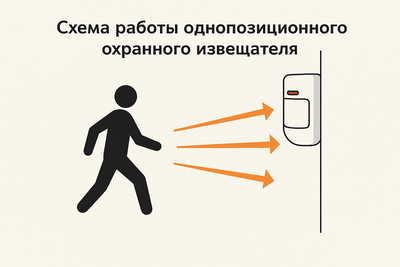
The principle of operation:
- It forms a sensitivity zone, for example, using infrared rays or radio waves.
- Analyzes changes in this area — movement, heat, etc.
- When triggered, it gives an alarm.
Examples:
Advantages:
- Easy to install (just one mounting point).
- Inexpensive cost.
- Suitable for small spaces.
Disadvantages:
- Limited coverage area.
- Sensitivity to interference.
Two-position security detector
The two—position detector** consists of two separate modules, a transmitter and a receiver, located at a certain distance from each other. A beam is formed between them, and an alarm is triggered if someone crosses this beam.
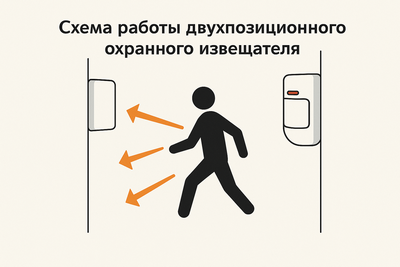
The principle of operation:
- One module emits a signal (usually an IR beam or a radio signal).
- The second module accepts it.
- A violation is detected when the signal is interrupted between them.
Examples:
- Active IR barriers.
- Radio wave linear detectors.
Advantages:
- Accurate detection of the intersection of the protected line.
- High noise immunity.
- Suitable for perimeter security, long corridors and open areas.
Disadvantages:
- It is more difficult to install (you need to verify the exact position of the transmitter and receiver).
- Higher cost.
- It requires stable power supply and proper configuration.
How to choose?
The choice between a single-position and a two-position detector depends on the conditions of use.
- Single-position models are suitable for most security tasks.
- Two—position detectors are used for perimeter protection of extended areas.
Zhurin Electronics Company produces only single-position security sensors for several objective reasons related to both technology and market strategy:
1. Specialization and production facilities
The company relies on the mass market segment, where inexpensive and easy-to-install solutions are in demand. Single-position sensors are cheaper to manufacture, require fewer settings, and are easier to operate than two-position sensors. This makes it possible to produce devices in large volume and with minimal maintenance costs.
2. The main sales market is indoor security
Single-position detectors are ideal for creating simple security systems, quick-install and mobile security systems. Two-position sensors are more often used in facilities with perimeter protection, which requires a different level of design and installation.
3. Technological simplicity and reliability
Single-position solutions are easier to install, configure, and maintain. The company focuses on increasing sensitivity, noise immunity and energy efficiency within a single position. This allows us to produce reliable and time-tested devices without unnecessary technical difficulties.
4. Price and availability
Single-position sensors are significantly cheaper than two-position sensors both in terms of purchase and installation. For many customers, the balance between price and efficiency is important, and Zhurin Electronics covers this need.
5. No need for complex calibration
Two-position sensors require precise alignment of the transmitter and receiver, which is not always convenient for installers and end users. While single-position sensors can be quickly installed even without high qualification.
More reasons for choosing single-position detectors:
- Easy to install and operate. Single-position detectors combine the transmitter and receiver in one housing, which simplifies installation, especially in conditions of limited space or complex infrastructure. This reduces labor and installation costs.
- Versatility of application. Such devices are effective for protecting various objects: from small rooms to outdoor areas. They can be installed in areas where the use of two-position detectors is difficult or impossible, for example, in dead ends, swampy areas or in places with limited access.
- Reduced equipment and maintenance costs. Single-position systems require fewer components, which reduces the overall cost of equipment and simplifies maintenance. This makes them attractive to customers who are focused on the optimal price-performance ratio.
- Adaptation to specific operating conditions. Single-position detectors are well suited for use in conditions where the installation of a second unit is impossible or impractical, for example, in areas with seasonal flooding or in areas with high vibration.
- Focus on development and improvement. Focusing on single-position detectors allows the company to work deeper into technologies, improve device performance, and respond more quickly to market needs.
Thus, the choice in favor of single-position security detectors is a strategic decision of the Zhurin Electronics company, aimed at providing effective, reliable and affordable solutions for ensuring the security of various facilities.