


Security systems play an important role in ensuring the security of buildings and territories. One of the important components of such systems are infrared (IR) detectors, which are used to detect moving objects, such as people, in a protected area.
Depending on the principle of operation and type of protection, infrared detectors can be linear or volumetric.
These two types of devices differ in design, principle of operation, scope of application, and efficiency. In this article, we will look at the main differences between linear and volumetric infrared detectors.
The principle of operation of infrared detectors
Infrared detectors use infrared radiation to detect objects that emit heat, such as humans or animals. Infrared sensors can be of two types: active and passive.
Passive Infrared Detectors (PIR): These devices respond to changes in thermal radiation in the detection area. They are usually used to detect movement in enclosed spaces or in open spaces.
Active infrared detectors work on the principle of radiation and reflection of infrared rays from an object. These devices are used to protect large areas or facilities where accurate and rapid response to changes in the security zone is important.
Both types of detectors can be both linear and volumetric, but their operating principle and design have significant differences that determine their features.
Linear infrared detectors
Linear infrared detectors (or linear IR sensors) are designed to protect a specific line or area bounded by two points, such as the perimeter of a building, fence, wall, window, or doorway. Such detectors operate on the basis of active IR beams that are directed from the transmitter to the receiver. When an object (for example, a person) crosses this area, the infrared beam is interrupted, which triggers the detector.
In our product line, linear detectors are represented by products with the letter L at the beginning of the model name after the brand name "SPLAV": L50, L70, L50RA, L70RA, L50 (L70) GSM and others.
Advantages of linear IR detectors:
- High sensitivity: Linear sensors can detect objects at a considerable distance. For example, they can work effectively on large perimeters (up to several hundred meters).
- Precise security zone: thanks to the infrared transmission line, it is easy to define clear boundaries of the security zone. Such devices can protect strictly defined areas.
- Reduction of false alarms: Linear detectors are less susceptible to false alarms, as they respond only to the physical interruption of the infrared beam, and not to any movement in the protected area.
- Resistance to external conditions: Linear IR detectors can be more resistant to external factors (for example, rain or strong winds), since their detection area is limited by a predefined perimeter.
Disadvantages of linear IR detectors:
- Limited coverage area: Linear sensors usually cover only one rectilinear area, and multiple devices must be installed along the entire perimeter to ensure complete security.
- They are not suitable for indoor security: their use is limited to the protection of external perimeters, as other types of detectors are required for indoor security.
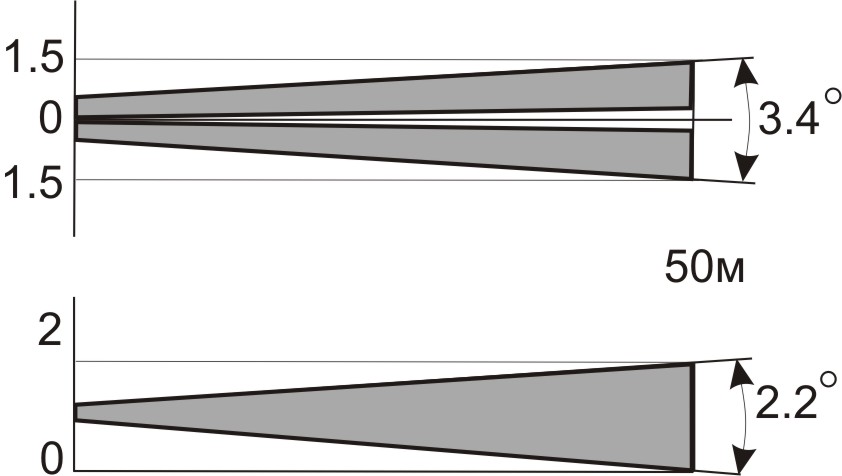
Diagram of the detection zone of a linear single-position detector (top and side view):
Volumetric infrared detectors
Volumetric infrared detectors (or volumetric IR sensors) can operate in a three-dimensional area, detecting movement within the entire protected volume — from floor to ceiling. They create an "invisible grid" of infrared rays or use technologies that can detect temperature changes within a large space.
Volumetric IR sensors can be both active and passive, but they often operate on the principle of "thermal vision" (for example, through arrays of pixels that respond to temperature changes).
In our product line, volumetric detectors are represented by products with the letter V at the beginning of the model name after the brand name "SPLAV": V10, v10RAv, v10GSM and others.
Advantages of volumetric IR detectors:
- Wide coverage area: volumetric sensors are capable of covering large areas, both horizontally and vertically. They can protect entire rooms, buildings, courtyards, and even large areas. Flexible installation: volumetric detectors can be installed at various points in the room or in an open area, creating a more flexible and convenient security system.
- Moving object detection: Volumetric sensors can detect movement within a protected area and can work effectively in rooms with moving objects, such as people or animals.
- Use in various environments: Volumetric IR sensors are suitable for the protection of both enclosed spaces and open areas such as courtyards, parks or warehouses.
Disadvantages of volumetric IR detectors:
- Risk of false alarms: volumetric sensors can be triggered by any movement in their coverage area, including accidental movements of animals, slight fluctuations in the air, even changes in room temperature, which can lead to false alarms.
- Lower accuracy in determining the location of the intrusion: since the sensor reacts to changes in temperature in the total volume, it may not accurately determine the point where the violation occurs, which makes it difficult to identify the source of the threat.
- Dependence on external factors: Such detectors may be more susceptible to external factors such as temperature fluctuations, drafts and humidity.
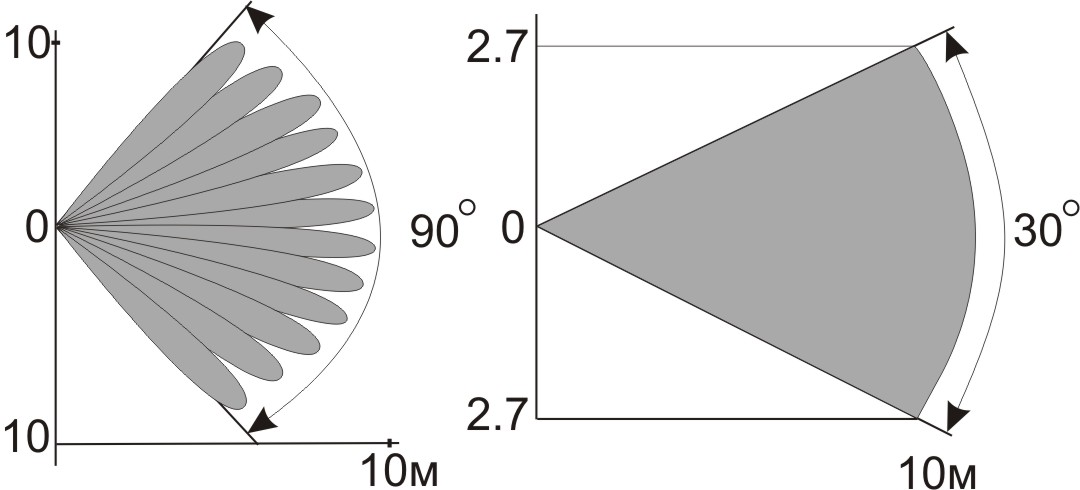
Diagram of the detection zone of a three-dimensional single-position detector (top and side view):
The main differences between linear and volumetric infrared detectors
>
| Characteristic | Linear inear infrared detectors | Volumetric etric infrared detectorsectors |
| How it works | Detection of infrared beam interruption | Detection of teman>Detection of temperatuerature changes or movement in volume |
| Security area | Protection of the linear zone, perimeter | Protection of the volume zone (indoor and outdoor areas) |
| Installation type | They are installed at certain points along the pethe perimeter | They are installed at one or more points to ts to protect a large area |
| Sensitivity | High accuracy in detectdetecting violations<tions | May be sensitivnsitive toive to false positives |
| Exposure to external conditions</span | Less susceptible to impacts (wcts (weathher) | They may be sensitive to changeshanges in external fanal factors |
| Indoor use | Mainly for perimeter protection</span | Suitable for indoor and outdfor indoorindoor and outdoor protection |
| Application | To protect external perimeters and lines | For protection of indoor spaces, large areas |
Conclusion
Linear and volumetric infrared detectors have their own characteristics and applications.
Linear detectors are ideal for perimeter protection or a specific linear area where high accuracy in detecting violations is required.
In turn, volumetric detectors are better suited for protecting large rooms or open areas where the ability to cover vast spaces is important. The choice between these two types of detectors depends on the specifics of the security facility, as well as on the requirements for the accuracy and sensitivity of the security system.